Showing posts with label USA. Show all posts

Wednesday

Frank Lloyd Wright's children's playroom

Interior of the Frank Lloyd Wright Home and Studio
at 951 Chicago Avenue in 
Oak Park, Illinois

Frank Lloyd Wright purchased the land and designed and built this home in 1889 when he was 22 years old and had just married Catherine Tobin. This is a photograph of the children's playroom where six of his children would have played. It was part of the two story extension to the east side of the home in 1895.  The room has glass windows along both side walls and a large central skylight, in the arched ceiling, which can be seen in the photograph, creating beautiful natural light. 

The home has been restored by the Frank Lloyd Wright Preservation Trust to its 1909 appearance, the last year Frank Lloyd Wright lived there with his family. 
The building was listed on the National Register of Historic Places in 1972. This is the United States government's official list of  buildings and structures considered worthy of preservation. The home was declared a National Historic Landmark in 1976 and is considered a must when touring the master pieces of the prolific architect Frank Lloyd Wright..

RESOURCES:The Frank Lloyd Wright Preservation Trust.

SEE ALSO: Winslow House in River Forest, Illinois

Plastic bottle car canopy

Designer Garth Britzman of  Nebraska, USA used recycled bottles to create this magical structure to shade a car. In Australia we call them car ports but we have never seen one like this before. The plastic bottles are filled with coloured water which creates the feeling of hundreds of flowers - around 1500 flowers to be more precise: old plastic bottle flowers that undulate in the air.
The project was funded to support the concept of plastic recycling to make something both practical and unique.

Tuesday

Winslow House in River Forest, Illinois


The Winslow House, designed by architect Frank Lloyd Wrightwas Wright's first attempt at reinventing the traditional suburban house.
Built 1894, the Winslow House was different to other homes in the area. It had a broad-eaved hip roof and a low chimney. The brick walls came straight up from a cast stone coping. The second story was covered in terra cotta stone.  At the rear of the house the studio was designed around a tree. Apparently the design was so unusual for the time that Mr Winslow stopped catching his normal train to avoid his neighbors' remarks.
Many of Wright's characteristic design elements are seen in this home including enhancing the horizontal which he achieves by dividing the facade into distinct horizontal bands and using wide bricks in the lower floor.  The house A projecting is "anchored" to the landscape by a limestone base. These features are seen in Wright's later Prairie Style homes. The building was added to the National Register of Historic Places in 1970 (building #70000242).

RESOURCE: Wikipedia 

Friday

A unique home

The Elrod House designed by John Lautner

This home is unique in many ways - the ultra modern design, the setting looking over Palm Springs and the fact that it was used in the 1971 James Bond movie Diamonds Are Forever - you know the one with Sean Connery where he scales the walls to the top floor to confront Whyte the reclusive billionaire owner of the casino hotel. Do you remember the fight scene in and around the pool with Bambi and Thumper and James Bond? In my opinion, however, the thing that makes this home an architectural stand out is it's designer and his vision.

The architect John Lautner was an apprentice of Frank Lloyd Wright which is evident in Lautner's style of having the home communicate with and be in harmony with the landscape. This style of organic architecture is seen in many of Lautner's designs such as The Chemosphere and Arango ResidenceLike Wright, Lautner's designs shows a strong involvement with geometric forms — the circle being evident in this home. 


In the Elrod House Lautner designed the domed roof as a shield from the hot desert sun and it fans out in nine petals as can be seen in the photo above. The house is constructed of reinforced concrete, very dramatic and very modern. The roof is curved, as are the walls. The curved glass walls open and shut like curtains to reveal the sweeping panoramic view of Mount San Jacinto, Mount San Gorgonio and the valley in which it is located. The local rock of the ridge the house is built on has been incorporated into the home's interior and exterior. The main living area has a large natural rock outcrop at the edge of the room integrating the house into its location and adding to the feeling of a flow between indoor and outdoor spaces.

In the Bond movie the Elrod House was Willard Whyte's winter retreat. It definately fits into the world of James Bond where everything is dramatic, state of the art and luxurious.  Just some of the features include:

  • A massive master suite that is a world unto itself.
  • Retractable glass and-aluminium sliding doors that allow the space to be opened to the view. 
  • A semi-circular swimming pool  
  • A large entertaining deck.  
  • A spiral stair case to a large guest house with two bedroom suites each with their own private bathroom. 
  • Maid's quarters.
  • A gym with a view.
  • 6.5 acres of land.

The home was last sold for US$5,500,000.00 in 2003 and  is currently being offered for US$13,890,000 by Expoint Realty.

This certainly is a one of a kind and unique home that has stood the test of time.


Share on Tumblr

Monday

Sandcastle creations


Look at the perfect minarets, look at the onion dome!
Architecture in minature.

Have fun in the sand.
Just a few of the competitions:
Fiesa, Portugal
SandFest - Port Aransas, Texas,  USA

GREAT RESOURCE ABOUT EVERYTHING TO DO WITH SAND CASTLES: 

Thursday

Alien or animal?

They are Horseshoe crabs which are considered living fossils.
Their blood is blue because of copper.

public domain image

Where can you find these amazing creatures?
The Japanese horseshoe crab is found in the Seto Inland Sea.
The Atlantic horseshoe crab is found in the Gulf of Mexico and along the northern Atlantic coast of North America. One main area is Delaware Bay, although stray individuals are occasionally found in Europe.
Horseshoe crabs can also be found along the east coast of India.

Monday

Snow crystals


Snow flakes by Wilson Bentley. (1865 – 1931)
Bentley was a farmer whose hobby was photographing snow flakes in Jericho, Vermont, USA.
Plate XIX of "Studies among the Snow Crystals ... " by Wilson Alwyn Bentley, "The Snowflake Man." From Annual Summary of the "Monthly Weather Review" for 1902.
In January 1885, Bentley took the first photomicrographs ever taken of a snowflake. He would photograph over 5,000 images of crystals in his lifetime.

"Under the microscope, I found that snowflakes were miracles of beauty; and it seemed a shame that this beauty should not be seen and appreciated by others. Every crystal was a masterpiece of design and no one design was ever repeated., When a snowflake melted, that design was forever lost. Just that much beauty was gone, without leaving any record behind." Wilson "Snowflake" Bentley 1925 

Bentley published an article stating no two snowflakes were alike. This idea caught the public imagination and he published other articles in magazines, including National Geographic, Nature, Popular Science, and Scientific American.
Bentley wrote many books and articles about snowflakes including Snow Crystals a book by W. A Bentley; Snowflakes in Photographs a book by W. A Bentley; Bentley's snowflakes a book by W. A Bentley; Studies of frost and ice crystals a book by W. A Bentley and Studies among the snow crystals during the winter of 1901-2 : a book by W. A Bentley.


Thursday

Living in the trees and how to build a tree house

When my daughter was nine years old everyone in her class was asked 'What would you do if you ruled the world?' A big notion, hey? My daughter's answer was 'Make everyone live in trees'! At first we thought her idea was small and strange but after a little consideration we realised the greatness of it. Tree houses and secret hiding places and forts are the stuff great childhoods should be made of - they connect with our imagination. The tree house, to me, and obviously to my daughter, was the coolest of all these constructions. Lately it has become obvious that you do not need to be a kid to enjoy a good tree house and many examples are being found around the globe. I have posted a few here to show you. If you scroll down to the bottom of this post you will find out how we built our own tree house if you are interested.


In Nahiku, Hawaii you can live in a tree and it has an amazing view of the ocean, volcano and mountains. The Nahiku Treehouse is in a giant mango tree in a rain forest over eight metres from the ground.  It is available for overnight visits if you are reasonably fit. I must tell my daughter!


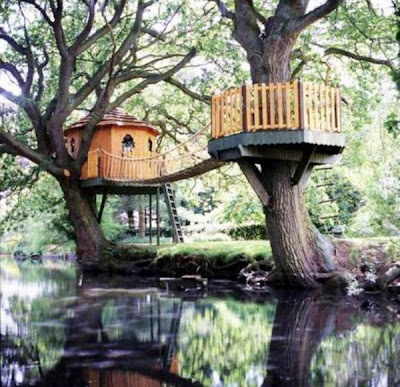
Bensfield Tree House, East Sussex, England
This luxury English tree house has all you need for a romantic or well-earned break far from the madding crowds. Built by ‘Blue Forest’ it provides a retreat for two within an hour of London. Crossing the rope bridge takes you back to childhood dreams yet forward into a grown-up treehouse retreat.
Tree house in India
Vanya Tree house is part of the Greenwoods Hotel in Thekkady, in the Kerala state of India, where you arrive by jeep to the forest area, and then trek up another kilimetre to reach this secluded tree house.
 
Vasa park, near Stockholm, Sweden.
 

BUILDING YOUR OWN TREE HOUSE
We did build a tree house, a while ago, but it was much closer to the ground than this as our tree house was for young children. We considered the tree and found a good strong, healthy tree. We considered all the components of the house: the platform, the windows and doors, the decks and railings, and also how children would climb into the tree house and get out. We were lucky enough to purchase a strong, sturdy second hand slippery dip from our children's preschool and incorporated it into the design.
The platform was built first to provide the support system for the whole structure. It was close to the trunk but with space to accommodate the tree's future growth. Then the floor was nailed down, then the walls and then the roof which was sloping and made of left over pieces of corrugated iron. No part of the tree house touched the tree but was just fitted snuggly around it. We also built a ramp as access which was possible because of a gentle slope behind the tree. It proved a very wise decision as all the very young visitors wanted to visit the tree house too and the ramp meant easy access for all.
Other considerations when building a tree house:
  • council permission
  • construction materials
  • height of people using the tree house and if they are children don't forget the growth factor!
  • safety such as height and strength of railings
  • ventilation
  • furniture such as seating: will it be built in or moveable?
Have fun building your tree house and I hope you have lots of helpers.

POSTED BY LESLEY SHARPE who also writes at GNN Good News Network where you can get lots more positive ideas.

LinkWithin

Related Posts Plugin for WordPress, Blogger...